
10 Feb Key Tech Pharma Process, Stage 3: Product Architecture
Throughout their development, pharmaceutical devices undergo a rigorous cycle of exploration, design, testing, and iteration to arrive at fully de-risked product architectures. As we have detailed in previous blog posts, Key Tech’s approach to this development process includes an initial phase in which candidate device concepts are developed and early technical risks are identified and assessed. Then, the team tackles a second phase, during which the design is taken through its paces to quantitatively de-risk technical feasibility, as well qualitatively refine the device’s human factors and use experience. The final output is a product architecture. The device will leave this phase in a high-fidelity state; the prototype evaluated in Phase 2 should both look-like and work-like the final product.
So, what happens once you have a design in a proven state? The cerebral efforts of development are behind you, and all that’s left is to bring it into the real world of manufacturing at volume and regulatory compliance.
Though sweeping changes to your product architecture are behind you, the transition from high-fidelity prototypes to commercial production requires a deft hand, with clear and cognizant communication between multiple parties: the client, the Key Tech team and any selected contract manufacturing organizations (CMOs). To streamline this transition, we have reflected on three considerations that should be kept top of mind in order to keep your program moving forward smoothly.
Revisit the critical product/program priorities
When a project kicks off, the interested parties spend time discussing what the product needs to be and do. If there weren’t many “hard requirements” (well-defined goals and limitations on the envisioned product), there were at least several “soft requirements” (want-to-haves) that the client may communicate to begin to limit the design space. However, as you progress through the design phases, some of these goals get kicked down the road until the design has matured. Though the capabilities of quick-turn prototyping vendors are impressive and improving year over year, there are frequently design nuances and residual risks that cannot be fully evaluated until this transition to the CMO. As this point in your program nears, we need to compile a set of outstanding requirements (and even nice-to-haves) to address now that they are no longer gated by manufacturing methods, materials, or stakeholder buy-in.
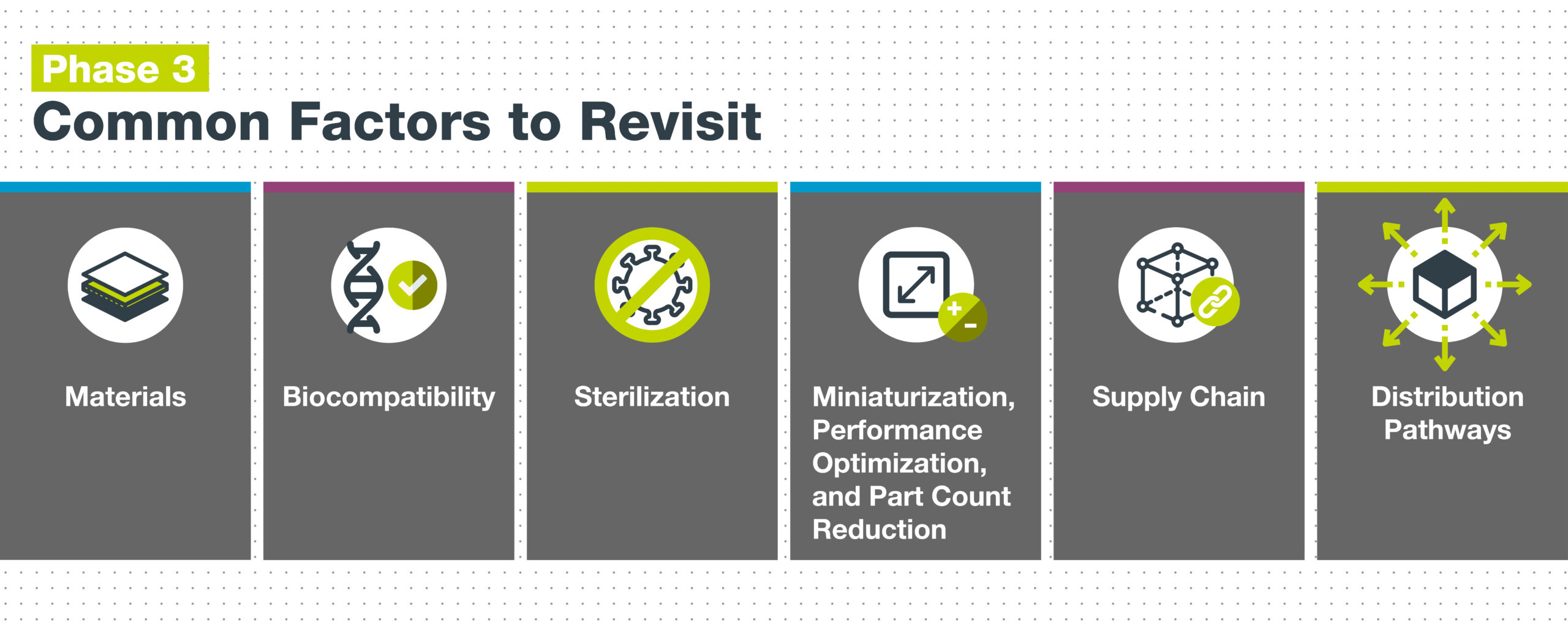
During Phase 3, it is time to revisit and lock down those (once far away) requirements and niceties. Each program is a bit different, but here are some common factors to revisit as you transition towards manufacturing:
- Materials: You should come out of Phase 2 with a plan for how the parts will be manufactured, and you may even have a good idea of what production materials are analogous to those you used in prototyping. If not, now is the time to nail down those specifics. Certainly be sure to consider mechanical properties that will be necessary to maintain any function, but don’t lose sight of optical or electrical properties either, if they’re key to your product’s success.
- Biocompatibility: Keep track of what regulations your parts need to meet and the degree of biocompatibility they will require. This will likely be based on whether any components of the design contact the patient directly or indirectly, such as via a fluid.
- Sterilization: Plan for what components of the product (if any, or if all) will need to undergo sterilization, and which methods will be effective given your program and product’s particulars. Now is a good time to double-check if any materials may be worth changing in light of the chosen process. In particular, we always like to keep an eye out for changes in the properties of elastomers post-sterilization.
- Opportunities for product miniaturization, performance optimization, and part count reduction: We often hear, “it needs to be as small as possible, as fast as possible, and as cost-effective as possible.” Well now, we finally have the opportunity to make a final pass on these. When transitioning from a prototype design, many fastening methods that were previously temporary (i.e. screws or dowel pins) can become more permanent (permanent snaps, ultrasonic welding, bonding). Often other features have been size-limited by prototyping methods. These final edits may allow for some miniaturization and cost reduction. Any of these opportunities are predicated on the assumption of a locked product architecture, so now is the time to tie up those loose ends and optimize the product in concert with the design team and CMO.
- Supply Chain: As you begin the transition towards manufacturing, your supply chain needs to get nailed down. With upstream considerations, consider whether those “exotic” materials or electrical components are really the only ones that will do the job. If your critical components can only be sourced through a single supplier, you need to have a contingency plan if they cease to manufacture that critical component line.
- Distribution Pathways: The downstream “distribution” chain is just as critical. Are there variations of this product (e.g., different concentrations of drug packaged in the product) that will require unique P/N’s, barcodes, or bona fide product configurations? Are there cold-chain considerations? Do you have a good sense of the impacts of shelf-life on the product’s overall performance? Do you accommodate the full range of connected components in the wider ecosystem (i.e. the full range of available luer lock syringes)?
The key to managing these new, and nuanced requirements is to keep tabs on how much residual risk these product changes carry. Some of these changes may require technical testing and potentially iteration to evaluate. What about validation of usability via a simulated use test? While in some cases, these evaluations must take place with injection molded parts, and some could be accelerated with quick-turn alternatives. The acceptable time to market and/or the costs of residual risk management may drive how conservative or aggressive you choose to be with these risks. It informs your ability to spin tooling revisions and may dictate the need to invest in parallel production and testing paths for the sake of schedule insurance.
This residual risk review goes hand-in-hand with planning for this transitional phase of product ownership to the CMO. It’s critical to structure the scope of the overlap between the product development team and the CMO, both in terms of dovetailing the transition schedule, as well as ensuring efficient technical knowledge transfer.
Ensuring productive CMO partnerships
A successful transition from designer to manufacturer requires alignment on the information they need to complete their dictated tasks. The CMO will likely have a batch of design input document requests, and to accelerate the CMO spin up, the product development team’s Phase 2 product architecture deliverables should closely align to those design input documents that will be requested by the CMO.
The biggest technical overhaul of the design is frequently the changes required to make the product designed for assembly (DFA) and its components designed for manufacture (DFM). This can be owned by either the designer or the manufacturer, but neither will thrive in a vacuum. If the designer owns this, they will need feedback from the manufacturers as to the design requirements of the production processes. Alternatively, if this design migration is owned by the CMO, the designers will need to be keeping tabs on the design changes to ensure that performance-critical features are maintained both from technical and human factors perspectives.
At the end of the day, it’s wise to involve both parties in this stage because they have present unique, complementary expertise. Though either the product development team or the CMO will perform the DFx realization, success frequently hinges on the thoughtful coordination of the two. As this third phase moves forward, check-in to ensure all teams are aligned on the pedigree, timing, and content of documentation and reviews.
This may also be the time to define logistical intentions of the final production supply chain, particularly as it may impact any design considerations. This would include assigning intended ownership of the part production, assembly, and packaging lines, as well as distribution channels. Often, we find that multiple parties in the program have internal capabilities that may (or must) be factored in as well.
Explicit requirement definitions
As the product evolved through the previous two phases, testing allowed for many technical and usability learnings. These provided strong evidence for what features are critical in the design, as opposed to which are simply elegant or ornamental. Now is the time to put all that knowledge into writing (if you haven’t already); formal requirements documents should be drafted and finalized in this phase. Document both critical and peripheral design decisions, and delineate them. Be sure to add requirements about features, labels, and feels that are critical for usability purposes. You have done extensive testing in the previous phases, now’s the time to flex that knowledge and put concrete numbers on your product’s technical requirements.
While requirements are making their way onto the page, this is also a great opportunity to plan for regulatory compliance-grounded technical testing and confirmatory human factors testing. Any requirements as dictated by regulatory standards should be folded into the aforementioned requirements documents. It may seem trivial, but be sure to define how and when the testing of first articles will be carried out. Who will be performing the tests? What prototypes will be used for the testing – do they need to be sterile, reusable, or resettable? Be sure to account for the direct costs and labor required to build up the number of prototypes needed for this exercise.
As requirements are being finalized, think about any other documents that should be developed or revisited during this time. A Failure Modes and Effects Analysis (FMEA) is a necessary tool to document the risks and mitigations of potential modes of failure in the device.
Conclusion
The transition from a defined and de-risked pharmaceutical device architecture to commercial manufacturing can seem like a minefield with gotchas around every corner, but our experience championing the commercialization of pharmaceutical and diagnostic instruments and devices, for use in the home, the clinic, and the lab, makes it just another day in the office theater for us (have we mentioned our office?). Want to learn more? Drop us a line at TalkToUs@keytechinc.com.
***This post was co-written by Thomas James & Katie Goetz

When not immersed in a novel, Katie enjoys taking naps, traveling, watching Pixar movies, and eating as many carb and sugar-heavy items as she can (interpret as: baked goods). She comes from an aggressively baseball family, and is thrilled to live in Baltimore and supports her favorite team, the ever-successful Orioles, as often as possible. Katie likely would be a Broadway star in a different life. You can often catch her mouthing show tunes (and only occasionally singing to herself) while doing her work. Though Katie does suffer from “resting nice face” and rarely is seen not smiling, her bubbly and outgoing personality is genuine. When she gets excited, she also tends to babble a little. Sometimes a lot. Which might be why this bio is long….
- Key Tech Pharma Process, Stage 3: Product Architecture - February 10, 2021