
12 Nov When There’s No Clear Solution: A framework for inventing and evaluating novel drug delivery architectures
Not every drug delivery challenge has an off-the-shelf answer
Drug volumes larger than any existing primary container. Preparation protocols that must happen onsite and still be usable. A device that needs to work across multiple drug types, not just one. A delivery system that misses its accuracy requirement after launch. These aren’t edge cases anymore. They’re becoming the norm.
When there’s no clear solution, you need a framework. Not a guess. Not a work around. A structured way to evaluate architecture decisions that gets your team to data faster and keeps everyone aligned on what matters: getting a working device to patients.
The framework: a systems approach
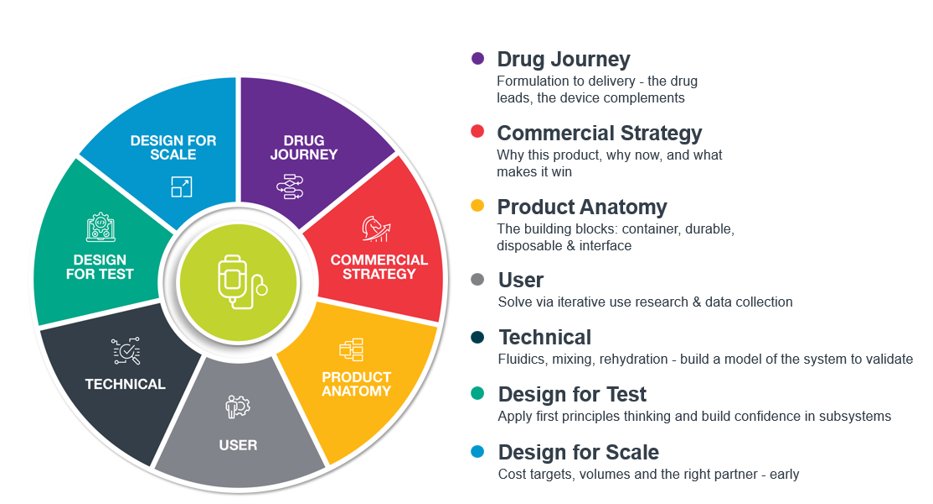
At Key Tech, the framework is built around a set of lenses that surround the product architecture at the center. Each lens surfaces a different set of risks. Apply the framework early and keep it open throughout development. It gives program leaders a way to identify those risks, prioritize them, and build a shared understanding across the team. That’s how you make better architecture decisions before years are spent testing the wrong thing.
How the framework plays out
Three programs came to Key Tech with completely different challenges. The framework gave each one a different starting point and a faster path to a solution.
A reconstitution therapy was producing use errors in the field. Nurses were consuming multiple kits to deliver one patient dose, and the regulator required it to improve. The drug journey was fixed, so the device had to absorb every constraint. The commercial strategy accepted higher device cost to buy usability and reliability, and the answer went from a two-part vial adapter to a larger multi-part assembly, deliberately.
A delivery system had been pulled off the market for missing its accuracy requirement. Every proposed fix was a guess. We applied the technical lens first: a first-principles model of the fluidic circuit separated and ranked every error contributor rather than argued about them. Then design for test took over: changes could be evaluated against the model before hardware was built, and test results fed back to validate it.
A large-volume platform needed to work with any drug company’s product. The commercial strategy demanded maximum reach, so the architecture delivered a generic drive unit paired with a primary container any pharma company can use. Product anatomy drove that decision, not the other way around.
Every program used the same framework. None of them started in the same place. The problem tells you which lenses to pick up first.
What’s your framework
Every architecture decision eventually reaches a patient. The framework exists to make sure it reaches them sooner, with fewer wrong turns along the way.
Apply it early. Use it to align your team on risk. Plan for parallel paths early. Your first concept won’t always survive the physics, and the teams that move fastest are the ones that aren’t starting over when it doesn’t. And bring in partners who fill the disciplines you don’t have. It takes a village to turn a bold product idea into commercial reality.
The question is simple: what’s your framework? If you don’t have one, we should talk. That’s what we do at Key Tech. We help you achieve what others can’t.
Interested in a deeper look at this framework in action?
Reach Andy to learn more at andy@keytechinc.com.

A history nerd at heart, Alexis fits right into the quirky culture at Key Tech (though she still can’t speak binary). Weekends are spent chasing her two boys and spending time on her boat.
- When There’s No Clear Solution: A framework for inventing and evaluating novel drug delivery architectures - November 12, 2026
- Summer Interns 2026 - September 16, 2026
- Ep 46 Timeline from Concept to Clearance - September 3, 2026