
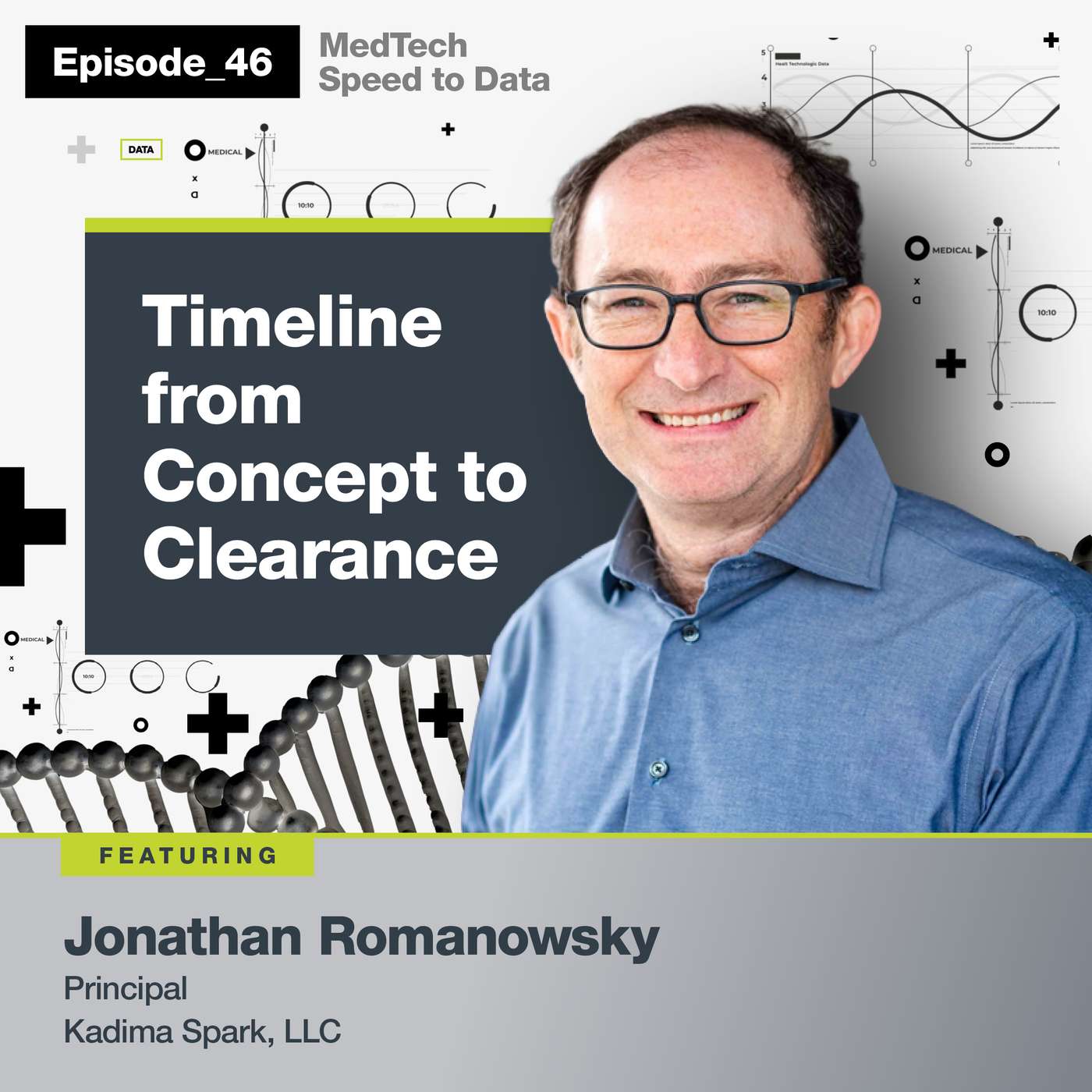
03 Sep Ep 46 Timeline from Concept to Clearance
Commercialization Insights from a Veteran in MedTech Innovation
Jonathan Romanowsky specializes in launching novel medical technologies, most recently at the molecular diagnostics innovator Inflammatix. In Episode 46 of the MedTech Speed to Data podcast, Romanowsky and Key Tech’s Andy Roger discuss the state of MedTech investment and the lessons Romanowsky has learned in technology commercialization.
Need to know
- A traditional career path was unsatisfying — Working at Bain & Company to consult for S&P 500 companies lacked the pace and impact Romanowsky was looking for.
- Pivoted by way of Stanford Business School — Getting an MBA in the Bay Area let him focus on the intersection of entrepreneurship and medical innovation.
- Discovered fulfilling career in molecular diagnostics — For the past 25 years, he has helped commercialize novel technologies for Telomere Diagnostics, CareDx, and other innovators.
- Key lesson for entrepreneurs — Stakeholders’ financial interests drive behavior and will raise or lower barriers to commercialization.
The nitty-gritty
Romanowsky assessed the state of MedTech funding and how entrepreneurs can approach commercialization. After the post-pandemic peaks and troughs, Romanowsky is optimistic about the future of funding but acknowledges that investor culture has changed.
“One of the realities of being in young companies is, until you have a product to sell, your customer is the next investor. You need to convince them to give you funds so that you can bring a return to them.”
With today’s high interest rates, however, getting investors’ attention is a big challenge for MedTech startups with their five-to-ten year development cycles. Other industries may deliver returns much faster.
“Investors are looking for a much quicker return on capital and much shorter timeframe to visibility,” Romanowsky says. “If you’re able to demonstrate that, then there are great opportunities for investment or acquisitions.”
From Romanowsky’s perspective, startups can adopt one of two commercialization models. Customers adopt platforms based on platform performance, including productivity and financial factors, rather than each assay’s performance. Leveraging existing platforms creates opportunities for startups.
“That is a much faster path to revenues,” Romanowsky says. “You don’t have to start the process from scratch… of getting decision-makers to bring on a new platform. If they already have it, they’re just adding a new test. It’s a great opportunity for nimble startups.”
The other path is demonstrating incredible economic and clinical value out of the test itself.
“You’re selling at the test level,” Romanowsky explains. “Unique characteristics around that test make it significantly better than anyone else’s. I try to create a moat relative to other groups trying to go after that same market based on clinical performance, like actual sensitivity and specificity. It’s that initial clinical evidence, and continuing to mount that evidence, that is most important.”
Data that made the difference:
Romanowsky emphasizes the importance of collecting two sets of data: market data and clinical or technical evidence.
Market data must demonstrate a significant unmet need with significant economic impact. When your modeling or market research identifies a defensible market, you can justify the opportunity and raise funds for the next step.
Evidence gathered during technical development and pre-clinical testing lets you show that your signal is working, maybe through a proof of concept. At that point you can go for the next raise.
“Once can do modeling and market research to build your case,” Romanowsky says. “If you’re presenting a story that makes sense to [investors] and to doctors and for the patients, then that’s where the magic happens.”
View the episode here:

A history nerd at heart, Alexis fits right into the quirky culture at Key Tech (though she still can’t speak binary). Weekends are spent chasing her two boys and spending time on her boat.
- Ep 46 Timeline from Concept to Clearance - September 3, 2026
- Ep 45 How We Ran a Clinical Study Without Millions - June 9, 2026
- Ep 44 The Real Cost of Adding Cybersecurity Late in Medical Device Development - February 4, 2026