

24 Sep Laser Integration
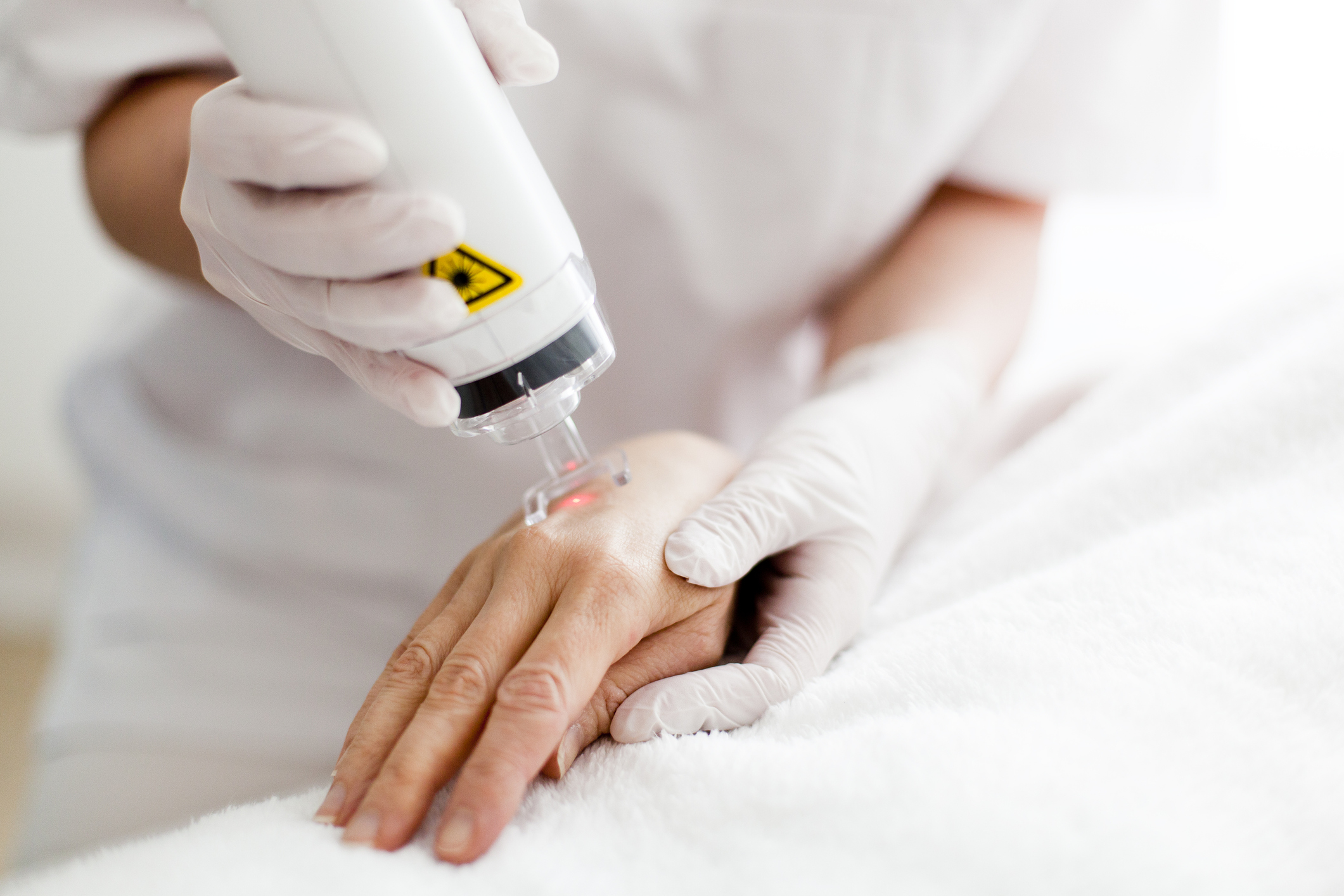
Lasers have powered a wide array of useful applications over the past 50 years, and recently their use in the medical and life sciences fields has been on the rise. Lasers are an effective way to transfer energy to a precise location while maintaining mechanical separation between the laser and its target, with common medical applications including sample fluorescence and precise, localized heating. Lasers are incredibly useful, and we at Key Tech have strong experience with integrating them into products safely and reliably.
Product Safety
Transferring high amounts of energy wirelessly and potentially invisibly with IR and UV lasers brings obvious safety concerns to laser products. The safety standard IEC 60825, “Safety of Laser Products,” aims to mitigate those risks. This standard divides laser products into four main classes, ranging from 1 to 4. Class 1 lasers are safe to stare at for extended periods of time; on the other extreme, even partial reflections from Class 4 lasers can cause skin burns and permanent eye damage. With such a wide range of laser energies regulated under the same standard, early and detailed planning for laser compliance is critical to successful product development.
Many of the provisions in IEC 60825 focus on protecting the end user in normal use. However, the standard also prescribes safety mechanisms for maintenance personnel, such as interlocks that prevent the laser from firing during servicing. These interlocks can be as simple as physical design that prevents the device from being powered while disassembled, or it can be a complex system of protective panels and sensors. One benefit Key Tech sees from designing early prototypes with this standard in mind is that our prototypes protect engineers and scientists – who are often overlooked as product users – from accidental laser firing on a product’s prototype units. These first users also provide valuable input on the usability of the interlock system, answering questions like “Do the interlocks work in all usage scenarios?” or “Is the interlock overly sensitive or tedious to work with?”.
Reliability and Performance
Beyond safety, the reliability and performance of laser systems are critical. How can we design a system that will last the full lifetime of the product, and how do we ensure that the laser behaves consistently as it ages?
Like many other semiconductors, the primary risk to laser diodes is thermal damage due to self-heating. Per the laws of the universe, some waste heat will be generated when converting electrical energy into optical energy. As laser temperature increases, efficiency decreases, which changes even more of the electrical energy into heat. When left unchecked, this feedback loop will cause the laser’s power output to be much less than expected while simultaneously overheating the laser. One way to compensate for this scenario is to “close the loop” by reflecting a small portion of the beam into a photodetector, and then adjusting the power delivered to the laser based on that feedback. Still, the laser can only get so hot before losing lifespan or outright failing, so getting waste heat away from the laser, through either passive heatsinks or active cooling, is critical.
In addition to heat, laser diodes are sensitive to ESD events and mechanical stresses. On a past project, Key Tech was tasked with identifying premature failures of a laser assembly. We determined that the cause was an assembly step that caused the circuit board containing the laser to flex if the fit was too tight. This stress was not enough to noticeably affect laser power when the device went through its initial checkout testing, but as the devices were cycled, the laser’s power gradually decayed until it became non-functional. Modifying the mechanical parts to give a larger clearance during assembly proved to be the solution.
Conclusion
Lasers are powerful tools for IVD and life science devices that live at the intersection of Electrical, Mechanical, and Systems Engineering. Key Tech’s multidisciplinary team has experience with both practical and regulatory challenges of laser integration.

In his free time, Ben enjoys bouldering, going to rock concerts, running, and biking. If he can’t be found out doing one of those, he is probably reading, playing video games, solving Rubik’s cubes, or baking.
- Laser Integration - September 24, 2025