

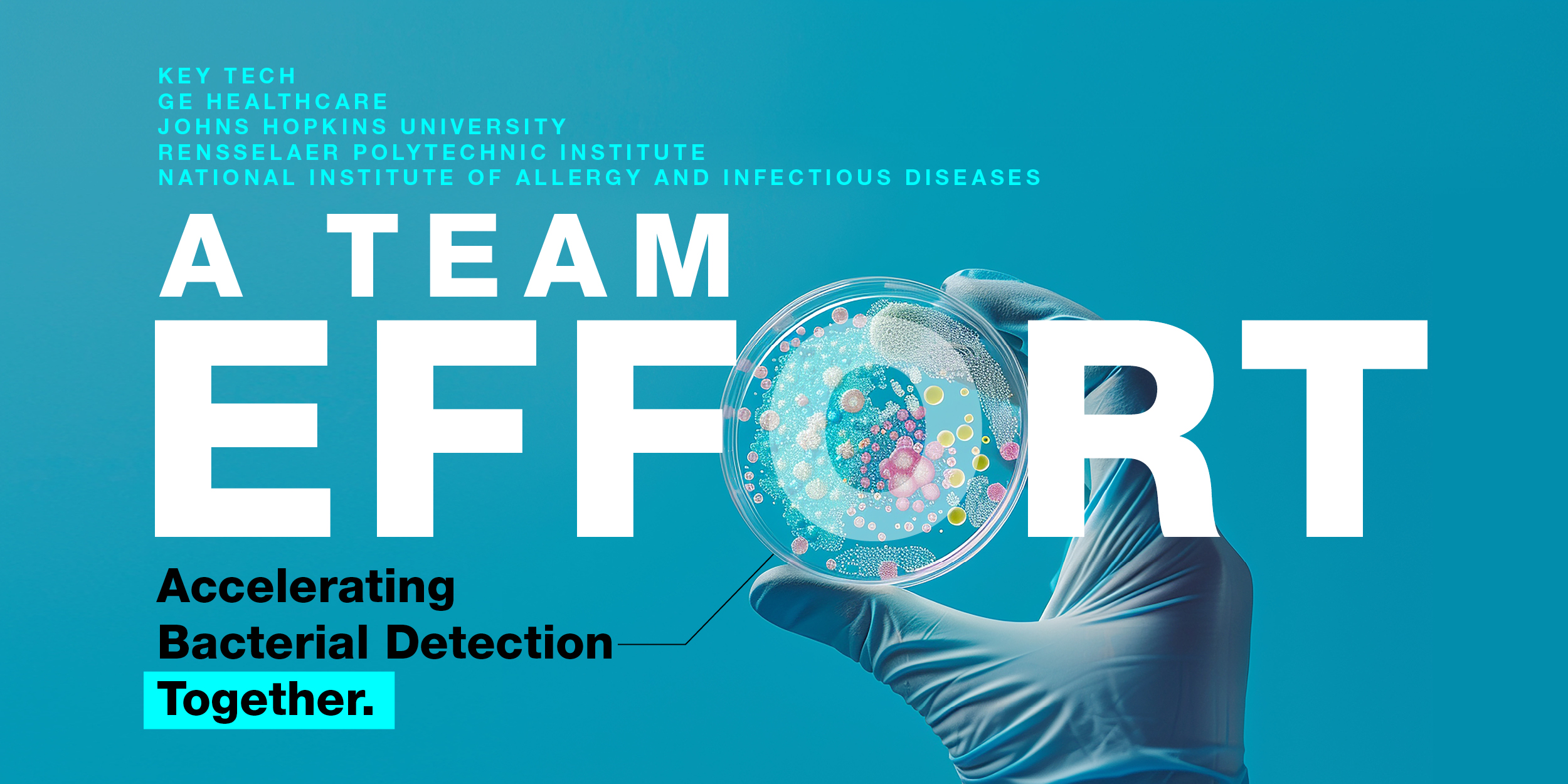
07 Aug Key Tech Joins GE HealthCare-led Team Advancing Bacterial Detection
Key Tech’s design and technology expertise will play a significant role in reducing bacterial detection and susceptibility testing turnaround times.
Key Tech announced today that it has been selected to provide design and integration services for developing the Single Cell RNA Response Profiling (SCRP) platform as part of a new project led by GE HealthCare. Funded by a $10 million contract from the National Institute of Allergy and Infectious Diseases (NIAID), part of the National Institutes of Health (NIH), this advanced technology development project aims to reduce turnaround times for bacterial detection and antimicrobial susceptibility testing from days to hours. Antimicrobial-resistant bacteria have become a significant cause of death worldwide. In the United States alone, the Centers for Disease Control estimates 35,000 people die every year from drug-resistant bacteria and fungi 1 — a rate that accelerated during the COVID-19 pandemic. 2
Existing test procedures take days to identify the bacteria and assess antimicrobial resistance. Since patients’ lives are at risk, physicians typically prescribe a broad-spectrum antibiotic immediately, before lengthy lab tests confirm the exact bacterial strain and possible resistances, despite the risks of increasing resistance.
“Today’s gold standards for bacteria detection and antimicrobial susceptibility testing can take days, delaying critical information needed for treatment,” said Dr. Ralf Lenigk, Principal Engineer at the GE HealthCare Technology & Innovation Center (HTIC). “Reducing diagnostic turnaround times could help care teams select the best antibiotic faster, which is critical for patients and effective antibiotic stewardship. Our early testing results have been promising, and we are excited to advance this research with Key Tech and our other collaborators thanks to this support from the NIH.”
GE HealthCare Technology & Innovation Center, a group within the company focused on incubating a wide range of emerging technologies, was awarded this NIAID funding and is leading a team comprising Key Tech, Prof. Tza-Huei Wang’s group at Johns Hopkins University (JHU), and Prof. Chris Puleo’s group at Rensselaer Polytechnic Institute (RPI) under the NIAID contract to develop and perform clinical tests with the SCRP platform. The microfluidics device will deposit bacteria from a patient sample into its nanowell imager and perform bacterial identification by real-time PCR and nucleic acid melt analysis before testing the bacteria for antimicrobial resistance.
“Key Tech’s contribution to this collaboration leverages our experience in high ramp rate PCR, optics and fluidic motivation,” said Key Tech Technology Manager Brett Wiley. “Besides designing the overall instrument, we will integrate the contributions from HTIC, JHU, and RPI through the device’s electronics interface and software.”
This project has been funded in whole or in part with Federal funds from the National Institute of Allergy and Infectious Diseases, National Institutes of Health, Department of Health and Human Services. Key Tech has received funding support as a subaward under Contract No. 75N93024C00051 to GE HealthCare.
The content is solely the responsibility of the authors and does not necessarily represent the official views of the National Institutes of Health.
(1) “More People in the United States Dying from Antibiotic-Resistant Infections than Previously Estimated,” Centers for Disease Control, November 13, 2019.
(2) “Antimicrobial Resistance Threats in the United States, 2021-2022,” Centers for Disease Control, July 2024.

A history nerd at heart, Alexis fits right into the quirky culture at Key Tech (though she still can’t speak binary). Weekends are spent chasing her two boys and spending time on her boat.
- Summer Interns 2026 - September 16, 2026
- Ep 46 Timeline from Concept to Clearance - September 3, 2026
- Ep 45 How We Ran a Clinical Study Without Millions - June 9, 2026