

26 Jun Bridging Agile and Structured Planning in Complex Product Development
When faced with a project requiring real-time issue support alongside critical milestones, Key Tech adopted a hybrid approach that combined structured, linear planning with Agile flexibility. We broke work into manageable sprints but still tracked to long-term deliverables and collaboratively prioritized tasks with the client, maintaining transparency through shared management. This method not only ensured steady progress but also fostered a sustainable, productive workflow in a dynamic environment.
In typical product development engagements, Key Tech manages the schedule and priorities internally based on pre-defined agreements with the client, such as scopes of work that outline deliverables and program timelines. This approach provides a clear roadmap, outlining key tasks and milestones that help the team stay organized and measure progress.
In contrast, other programs may use an Agile approach, where work is managed in short cycles to prioritize flexibility. Managing the schedule and priorities dynamically based on collaborative planning with the client, such as iterative sprints that outline deliverables and allow for regular feedback and adjustments. This approach provides a flexible roadmap, outlining key tasks and milestones that help the team stay adaptive and measure progress. While this method allows the team to adapt quickly, it can make long-term timelines and budgets harder to manage and pose challenges in maintaining cohesion for large, complex projects.
But what happens when you find yourself between these two worlds: needing the flexibility to respond to changing priorities while also pursuing long-term goals with interdependent tasks? Striking a balance between these competing needs becomes essential to maintain performance and mitigate team stress.
We recently faced such a challenge. Key Tech had successfully built a fleet of complex alpha instruments and delivered them to the client site for assay integration testing. The next program phase required us to support the client testing by addressing issues and maximizing instrument up-time, while also advancing longer term goals of instrument characterization and design improvements.
As the client’s needs evolved daily, we found ourselves struggling to balance urgent, high-priority support tasks with equally critical long-term milestones. The constant shift in priorities began to strain the team, as they tried to maintain progress toward the fixed project timeline while remaining responsive to arising issues.
Moving the project forward toward commercialization presented a complex challenge. At the beginning of the program, we aligned with our client on key goals, providing the structure needed to manage the larger, fixed parts of the project. Together, we outlined these goals and broke them down into clearly defined objectives and deliverables. This allowed Key Tech to generate labor estimates and build a bank of structured deliverable tasks, establishing a solid framework to manage scope, schedule, and cost.
In parallel, the client site operated a fleet of alpha devices undergoing daily assay integration and testing. To support this ongoing work, Key Tech received frequent ad hoc requests for upgrades and repairs, these were the support tasks critical to maintaining assay progress but not directly tied to the predefined commercialization milestones. The core challenge was balancing these two workstreams: structured deliverable tasks with clear endpoints, and unpredictable support needs, all within a fixed resource pool and a dynamic workload.
To address this, we found a project management structure that allowed us to make progress on long-term project goals while remaining flexible and responsive to the client’s daily needs.

Incremental Progress with Agile Sprints
For day-to-day management, we leveraged the Agile framework. We managed the project over two-week sprints, enabling us to tackle tasks incrementally and deliver progress on program goals at each sprint’s end. This approach also allowed us to dynamically incorporate feedback and adjust plans as priorities evolved.
We began each sprint with collaborative planning sessions with our client. This ensured alignment on the workload, discussing which tasks to include. Each sprint plan allocated only available resources based on the team’s capacity, which helped prevent overburdening and burnout. We drew from the defined backlog of deliverable tasks and support tasks, which could include new tasks or those previously deprioritized.
During these planning meetings, we were able to continuously evaluate how short-term priorities impacted the broader project. For example, if we prioritized a high volume of support tasks, we assessed the effect on long-term goals: Would this impact our ability to complete program deliverables? If so, was that an acceptable trade-off?

Managing Unexpected Support Needs
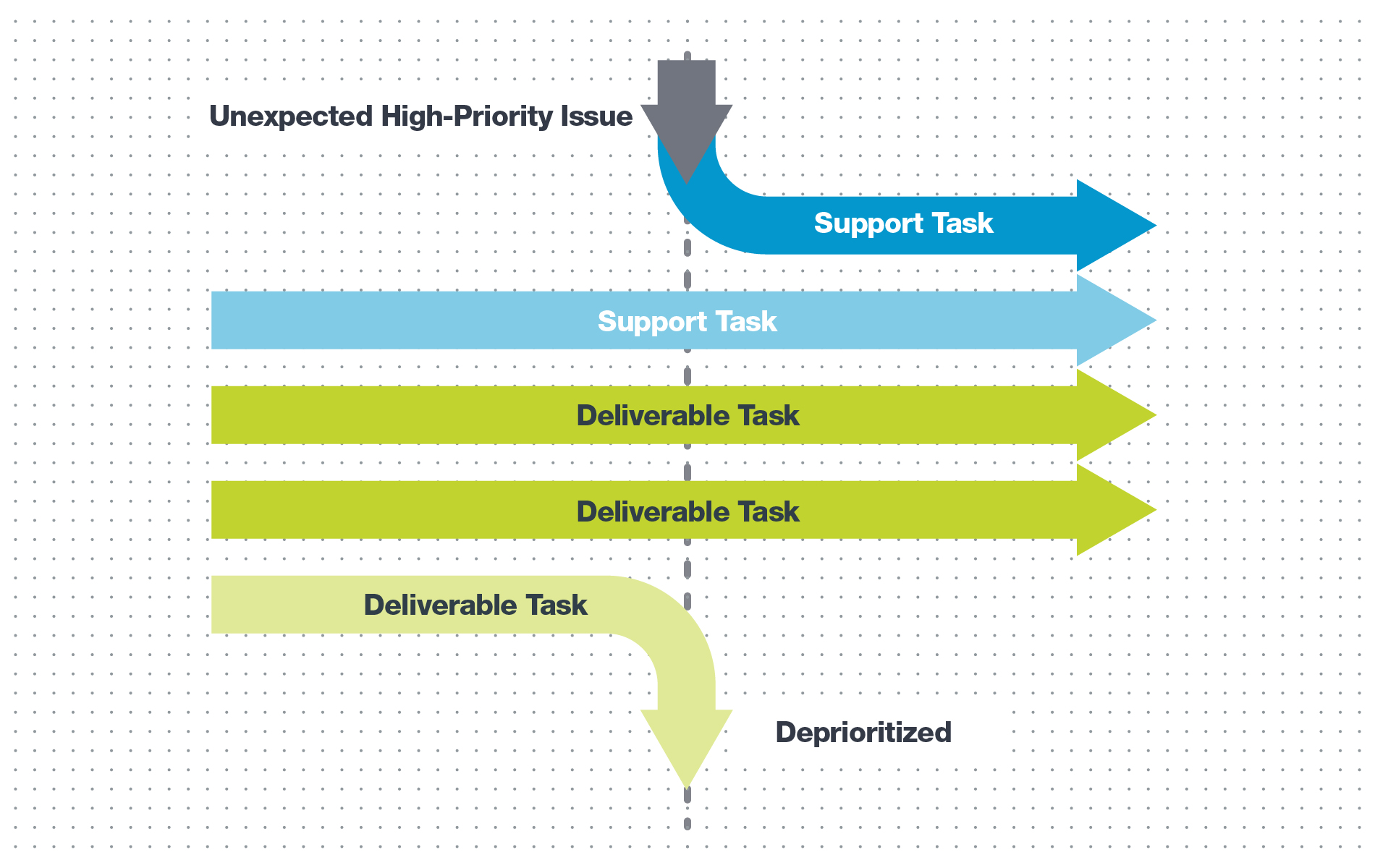
Inevitably, unexpected support arose during the sprint. Our management structure proactively included a process for dispositioning these needs. By clearly defining sprint tasks, we could track the impact of new support tasks in real time. Instead of pulling team members off their assigned work without a plan, Key Tech and client leadership reviewed workloads together to determine which tasks should be deprioritized to address urgent issues.
This process reduced team stress and maintained transparency, as all parties understood the trade-offs. Collaborative decision-making also encouraged thoughtful reflection: was addressing the issue immediately worth delaying other work, or could an alternative solution keep the project on track? In some cases, waiting for the resource to complete their current work proved more effective than reassigning tasks mid-sprint.
Sprint Reviews and Status Reporting
At the end of each sprint, we held sprint reviews to present results, gather feedback, and discuss progress toward overall program goals. When unexpected support tasks meant that priorities had shifted during the sprint, we communicated the impact on the overall program timeline.
Regular status reports provided visibility into progress toward key milestones and informed prioritization decisions for the upcoming sprints. By tracking any support time as discrete tasks, we quantified the effort dedicated to resolving issues, gaining valuable insight into the program’s health. For instance, if significant time was consistently spent addressing a recurring issue in the instruments, we could consider reprioritizing a longer-term task to investigate the root-cause and implement a long-term solution.
Leveraging JIRA for Transparency and Efficiency
A critical factor in the success of this approach was our use of JIRA for task management. We maintained a JIRA project for task tracking and a separate project for instrument issue tracking. Both Key Tech and client teams had access to these boards, ensuring full transparency.
Using the same platform made it easy for client team members to report issues and link them to relevant tasks in future sprints. This seamless integration improved communication, allowing both teams to stay aligned and respond quickly to new developments.
Outcome: A Balanced and Engaged Team
The hybrid approach successfully balanced long-term goals with flexibility, fostering transparency and collaboration across teams. With clear, short-term goals and structured sprint plans, team members avoided overload and felt more engaged in their work. Meanwhile, leadership could monitor long-term progress while adapting to day-to-day needs.
By limiting the scope of each sprint to match team availability, we maintained steady progress without sacrificing team morale. The result was a more sustainable workload, more efficient progress meeting long-term goals and addressing short-term issues, and a stronger partnership between Key Tech and our client. To learn more about our project management process, click here.

Brett holds an A.A.S. in Electrical Engineering Technology, a BEng in Electrical Engineering (Magna Cum Laude), and a MEng in Industrial Engineering & Management from Arizona State University, where he also earned a Lean Six Sigma Black Belt Graduate Certificate. He is a certified Project Management Professional (PMP) and holds a CSCMP Supply Chain: Manufacturing and Service Operations Professional Certificate.
Outside of work, Brett enjoys spending time with his family and engaging in outdoor activities
- Manufacturing Conscious Product Development That De-Risks Transfer - March 30, 2026
- Bridging Agile and Structured Planning in Complex Product Development - June 26, 2025