

21 Mar Optics Integration in Tech
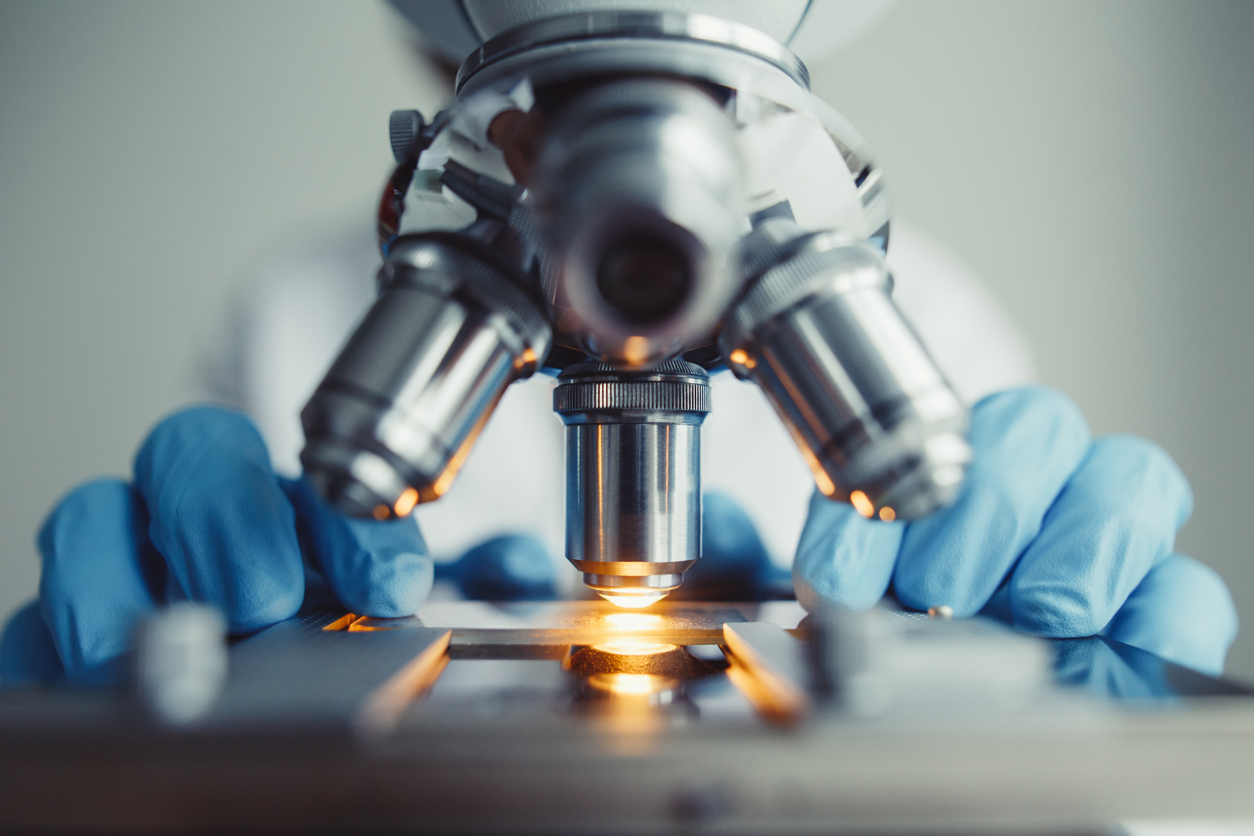
Key Tech has implemented optical solutions in medical and industrial systems for the last 20 years and has experience with both non-imaging (or anidolic) applications and imaging applications (microscopy). Microscopy is the field of optics that uses a microscope to image a sample, and has evolved dramatically in recent years with advancements in camera sensor technology and image processing power. Component costs have been reduced significantly, enabling applications of microscopy systems in many areas, including part inspection (machine vision), life science, medical devices, and even in some consumer products. Integrating optical systems into products requires careful design choices to ensure reliable performance without interference and artifact from internal and external sources.
MICROSCOPY BASICS
Before getting into how microscopy systems are integrated into a product, there are a few basics that help contextualize the important design decisions. Understanding these is important for establishing system architecture and product requirements. The diffraction limit is a measure of the smallest feature that can be resolved by a traditional microscope and is a function of the numerical aperture (N.A.) of the microscope objective and the wavelength of the light. Other metrics to consider are the working distance and field of view, which are the distance between the lens and the sample and the area that the system can image.
Lighting conditions are also informed by the preferred microscopy technique for the application. The simplest technique is bright field microscopy, which uses light passing directly through the lens parallel to the lens body and into a camera sensor. Darkfield microscopy uses a light source positioned to avoid the lens and only allow light scattered by the sample to reach the camera sensor. Oblique illumination microscopy is a middle ground where some incident light passes directly into the lens at an angle to increase contrast with a shadowing, 3-D effect. Phase contrast microscopy uses additional hardware to filter and condition the light from the source to enhance contrast. Phase contrast, dark field, and oblique microscopy are often used to enhance transparent, colorless images and reveal features that may be invisible in bright field images at the cost of introducing additional hardware and tighter alignment requirements. Image resolution is also dependent on lighting conditions and will need to be optimized for the objective being used so that features are not either washed out due to too much light or in need of more light to increase contrast.
DEFINING YOUR SYSTEM
It is important to understand the goals of the microscope system before selecting components and starting the design process. When selecting components, we will ask a few questions: What size are the smallest features we need to resolve? Are there limitations on the allowable wavelengths of light that will be exposed to the sample? Is the sample transparent? How fast and far, if at all, will the sample and/or lens system be moving? Which microscopy technique(s) do we need? Are there constraints on the working distance or the field of view?
Camera selection is a balance of achieving design specifications without excessive data consumption. The size of the camera’s sensor may impact the field of view for a given objective and lens tube, while pixel size affects the minimum feature size the system can resolve, assuming we’re operating well above the diffraction limit. It is important to optimize pixel density by balancing image resolution and image size. Large images slow down image capture rates and can have a significant impact on downstream image processing requirements.
SYSTEM DESIGN
Once we have defined specifications for the system, we can begin selecting components. Selecting components for an optical system is an optimization exercise with illumination, magnification, working distance, and numerical aperture as the major variables. Lighting wavelength and numerical aperture are related to the diffraction limit mentioned above and must be carefully considered if we are trying to resolve very small features.
Achieving stable focus is a major challenge in microscopy system design. As magnification increases, so do the requirements for tight alignment of the system, precision and accuracy of focusing, and measures to keep vibration to a minimum. In scanning applications, in which the final image is a compilation of multiple individual images stitched together, maintaining focus through the scan is very important and we may need to implement real-time hardware or software auto-focus solutions. We also need to consider stage selection for motion control in scanning applications, and ensure that the camera, stage, and illumination subsystems are tightly integrated. This is particularly important when we are collecting multiple images through the thickness of the sample (“Z-stacking”) and when imaging speed is critical.
Illumination is often the hardest challenge of a microscope system, particularly for transparent and semi-transparent samples, and is highly dependent on the microscopy technique(s) needed. Early prototyping of the optical system is critical, allowing for quick exploration of different illumination techniques to identify the best solution. At this point, it is important to engage the eventual stakeholder(s) with an interest in image quality (scientist, pathologist, image processing engineer, etc) to provide feedback and enable rapid iteration of the prototype system. Bright field imaging is the simplest with the only requirement being a powerful enough light source. The contrast-enhancing techniques add additional hardware to align the source and either direct (oblique and dark field) or properly filter (phase contrast) the light. Traditional phase contrast requires very precise alignment of the illumination components and objectives and must be carefully considered during system design.
The optical system footprint will often drive other details of the overall device design. Optimizing the footprint can be a sort of puzzle using mirrors to bend the light path into a shape that fits in the desired area with other subsystems reacting as necessary. This often necessitates the design of a custom lens tube, or the assembly of multiple off-the-shelf components to build the folded light path. Balancing so many details and constraints while maximizing image quality is what makes microscopy such an interesting design challenge. This science may be microscopic but its impacts are enormous and we would love to continue helping clients dive into optics.

In his spare time, you can find Paedyn playing/watching sports (maybe being the biggest Cavs fan you’ll ever see), lifting weights, generally just trying to be as athletic as possible, playing guitar, or obsessing over One Piece.
- Optics Integration in Tech - March 21, 2024