12 Jul 5 Best Practices for Transferring Your Design to a Contract Manufacturer
A question our clients often raise is when, exactly, to hand things over to a contract manufacturer (CM). Waiting for a refined design is tempting. In our experience, though, getting CM feedback early in development is critical to optimizing product designs, assembly and checkout processes, and production costs. Here are five lessons we’ve learned about transferring product designs to a CM.
1. Secure your supply chains now
We recommend ordering critical components to support clinical trials or early production as soon as you can justify doing so based on early performance testing.
Supply chain conditions have improved since the depths of the COVID-19 pandemic, but we still face issues with many critical components. By the time you choose a CM, it may be too late to source the semiconductors and other essential components you designed around in time for production.
You’ll find engaging with candidate CMs is much easier when they know you’ve lowered their risks of supply chain disruptions.
2. Leverage your CM’s expertise
As you evaluate potential CMs, consider how their capabilities complement your own. They are the experts in supply chain management, assembly, and checkout. Including their expertise in your product’s design can substantially reduce scrap rates or assembly times.
Also, consider what degree of design file ownership they can sustain. For example, can your product owner handle change control for all aspects of engineering design after design transfer? If not, you need a CM with sufficient engineering staff in appropriate disciplines.
3. Be willing to select multiple CMs
Few contract manufacturers are all things to all customers. Most specialize in particular types of products or subassemblies. If appropriate for your product, don’t be afraid to choose one CM to produce your disposable elements and another to build the durable electromechanical device. This way, you get the best costs and quality for each.
4. Select your CM sooner rather than later
We recommend you research the CM landscape while the project is still in the planning phase. Draw up a list of candidates with the product experience and capacity appropriate for your project.
During the Alpha development, you can visit potential CMs to observe their facilities and assess their project fit.
As you begin Alpha Testing, seek solicitations from 3-4 candidates. Share the Alpha design and estimates of your product’s BOM costs, assembly times, and checkout times. That way, each CM can make reasonable projections of time and material costs.
Beta development is the last best chance for critical DFx decisions. Bring your CM in at the start to leverage their expertise before design changes become prohibitively expensive.
The benefits of early selection also flow the other way. Your CM needs time to plan resourcing, accommodate lead times, and for process development and tooling. Having visibility and the opportunity to provide input during development reduces risk and encourages CM investment in project success.
5. Unit billing can wait
Locking in unit pricing when designs are still fluid creates risk for everyone. You don’t want to discover that your initial price assumptions are too conservative. Likewise, the CM does not want to lose money because assembly has become more complex than planned.
Since you’ve chosen your CM early, you reduce everyone’s risks by paying for your pilot builds on a time and materials basis. Both parties can work out the kinks in design and assembly without shouldering too much cost risk. Once you have a production-ready design, you can switch to unit billing.
Conclusion
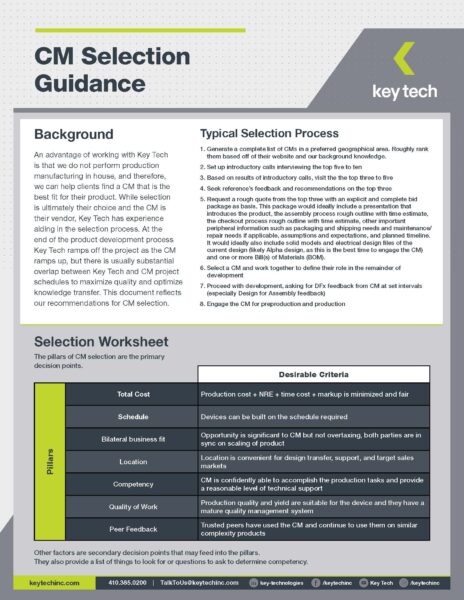
Adopting these five best practices streamlines the design transfer to contract manufacturers. CM feedback throughout development leads to more cost-effective designs, manufacturing, and assembly processes. Moreover, treating the CM as a partner will make them more invested in your product’s success. Learn more about our CM selection guidance by downloading our CM Selection Worksheet. Questions? Reach out to us at TalkToUs@keytechinc.com to discuss your design challenges.