
06 Jan Thinking About Testing in Product Development
The outset of a new project is like the start of a new year, a time rich with possibility. The beginning of any project is the most crucial period: The process you follow from the start will determine your likelihood of a successful outcome.
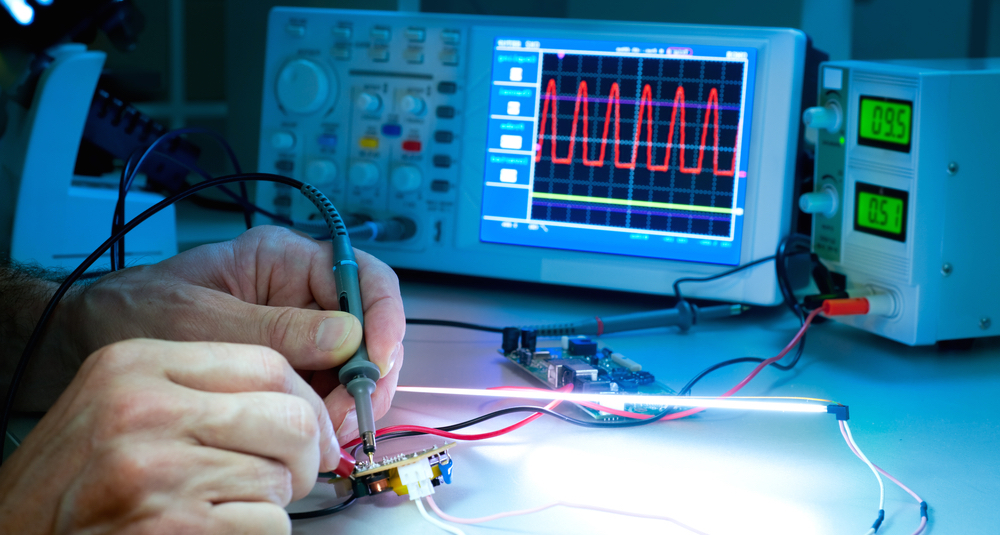
In the course of estimating and planning the scope of a new undertaking, one critical aspect is often overlooked. I’m talking about the development and use of custom test tools, which monitor and analyze outputs as you move toward a finished product. While they’re arguably the least glamorous aspect of the product design process, it’s vital to include creation of custom test tools in order to automate data collection and fully understand product performance.
Why the focus on custom testing, especially given the availability of off-the-shelf instruments like oscilloscopes, commercial gauges, and software test suites? Because while off-the-shelf testing products can be leveraged for a variety of applications, they’re often too broad to monitor progress with the kind of precision you’ll need when testing your specific new product. You’ll often need more specialized, less intrusive, methods of collecting data and monitoring outputs while simulating real operating scenarios.
And as we’ve noted before on this blog, the key to making an optimal product is to test it every step of the way. That means designing and using appropriate, customized tools.
Consider Testing From the Start
Not surprisingly, the tests depend on the nature of the product, which means you have to be thinking about testing from the beginning. As your design team identifies the requirements of the product, they should be thinking about how each requirement can be tested, and how to implement those tests. Custom test tools may exist separately from the device, or be integrated into hardware, or something completely different. They may take the form of software or firmware, be simple or complex, or have mechanical and/or electrical parts.
You may need to create and validate a custom software application to ensure certain elements of a system are functioning properly during prototype testing as well as final product verification. Or you might have to come up with a software architecture that allows a user to jump into a diagnostic mode at any point to run low-level operations without generating errors. You might need software that can read sensors directly or control system actuators. You may need a software tool that automates cycle testing and allows data to be collected during nights and weekends, which will shorten test and debugging iterations.
Many medical devices, for example, include a disposable component, like a reagent cartridge, that has to be developed in parallel with the main system. You may need to design a test cartridge or a simulator to help fine-tune the device design, at least until the actual cartridge is ready to be integrated. This approach has notable value when early generations of the actual cartridge are in limited supply, expensive, or only appropriate for single use.
In these devices, plastics and fluids often come into contact with mechanical and electrical components. To know what kind of tools you’ll need, you have to identify all the possible interfaces, break them down into simple pieces, and figure out how to measure them. It is critical to ensure that the test components are suitable for the intended application and data collected with them is valid. Characterization of test tools will give you the confidence needed to make design decisions based on the collected data.
Simple Test Tools
Of course, a testing tool can also be simple. In a past project, we had to know exactly how a device we were developing would pierce patient skin, and no one on our team was about to volunteer. So we tested the device with a hot dog, which showed us how to fine-tune the device to make it more effective.
The tools you build will sometimes have only one application. But it’s not unusual for custom testing tools to be created out of necessity – and then to become a central element in future product design, verification, electrical safety testing, and even manufacturing checkout tests. So it can happen that an unusual custom tool has myriad applications down the road.
We’re strong advocates of testing early, testing often, and testing correctly, and that means taking the time and resources to identify and build the right testing tools for the project. And what that process lacks in glamour, it makes up in efficiency. We’d be happy to talk more about our process for developing customized testing tools.
In the meantime, happy testing!

He received a BSEE from the University of Maine and an MSEE from the University of Maryland with a concentration in microelectronics. He is also a registered professional engineer. Outside of Key Tech, Jake and his wife stay busy chasing around their two young children.
- Best Practices for a Product Requirements Set - February 23, 2022
- Remote Teams: A Structure that Works - March 20, 2020
- Thinking About Testing in Product Development - January 6, 2016