

05 Mar Benefits of Consumable and Instrument Development by One Partner
Parallel consumable and instrument development is required to hit key milestones during fast-paced development programs. As the consumable complexity increases to meet the ever-growing demand of complex assay/chemistry processing or more data-driven medical devices, the instrument/consumable interface also grows in complexity and is typically a critical subsystem within an instrument design. The ideal development team will architect, design, and prototype BOTH your consumable and instrument with a holistic view of the system. The team at Key Tech has seen this model work extensively in the IVD market but has also applied it to other markets such as medical device, life science, cell and gene therapy, and pharmaceutical drug delivery.
Key Benefits of Parallel Development:
There’s no doubt that parallel consumable and instrument development with one partner provides benefits to the client.
Those advantages can be boiled down to three simple things:
- Saving time – Streamlined processes done in parallel eliminate the need for one vendor having to wait on the other, wasting precious time. Additionally, for those occasions when challenges arise, they can be addressed quickly in both the consumable and instrument providing a shorter timeline to architecture freeze.
- Saving money – Parallel development also minimizes the chances of one system component being changed significantly without the other system being adjusted accordingly. This issue can cause months of delays and significant cost overruns.
- Preventing go-to- and post-market challenges – The holistic development of the product allows for intelligent decisions to be made from beginning to end; ultimately creating a better product for market. One vendor also allows for efficient solutions for those bumps in the road that happen.
1. Early De-Risking
Developing the instrument and consumable in parallel, under one roof, provides another layer of de-risking to the process; allowing teams to identify areas of risk, like thermal interface, electrical interface, fluidic control and monitoring interface, or detection interface, early.
Thermal risk typically needs to be addressed early because the temperature of the fluid in the consumable often need to be controlled very precisely and uniformly. However, in many cases the temperature cannot be directly measured or heat distribution needs to be optimized over multiple iterations. In order to these goals, the instrument and consumable should be designed in concert to reduce schedule and cost.
With the push to make consumables smart and connected, specifically for medical devices, many consumables have custom sensors to relay information back to the instrument. It’s essential for the electronics of the consumable to accurately and reliably connect with the instrument so the system can be used as intended. Whether a user loads a consumable or an instrument accepts and automatically loads the consumable, it’s ideal to have one design partner to handle both sides of this interface to ensure that the numerous design details (such as reading distance, physical and electronic interferences) have sound rationale behind them.
Fluidic control accuracy is essential when moving or aliquoting fluids on the consumable. There are several variables that can affect volumetric accuracy including: the pumping method, material selection, fluidic channel/chamber geometry, fluids properties (e.g. viscosity, temperature), air bubbles, etc. To optimize the myriad of variables, design tweaks can occur on either the consumable side or the instrument side. These factors make it even more important that the consumable development is done in parallel with the instrument.
With so many variables at hand, single partner, multidisciplinary de-risking prevents delays and ensures holistic system design as development progresses. To ensure optimal design, the consumable and instrument should be tested together for major workflow steps.
2. Holistic Architecture Decisions
During the parallel development process, designers and engineers responsible for both the consumable and instrument are always thinking ahead and asking questions that relate them both, like:
- How does the consumable get loaded into or on the instrument?
- What interaction, if any, does the user need to perform with the consumable before it’s loaded into the instrument?
- Where are the interface points between the instrument and the consumable?
- What features are critical to be on the consumable and what can be handled on the durable instrument?
Not all questions are so broad. Many relate to specific interfaces such as:
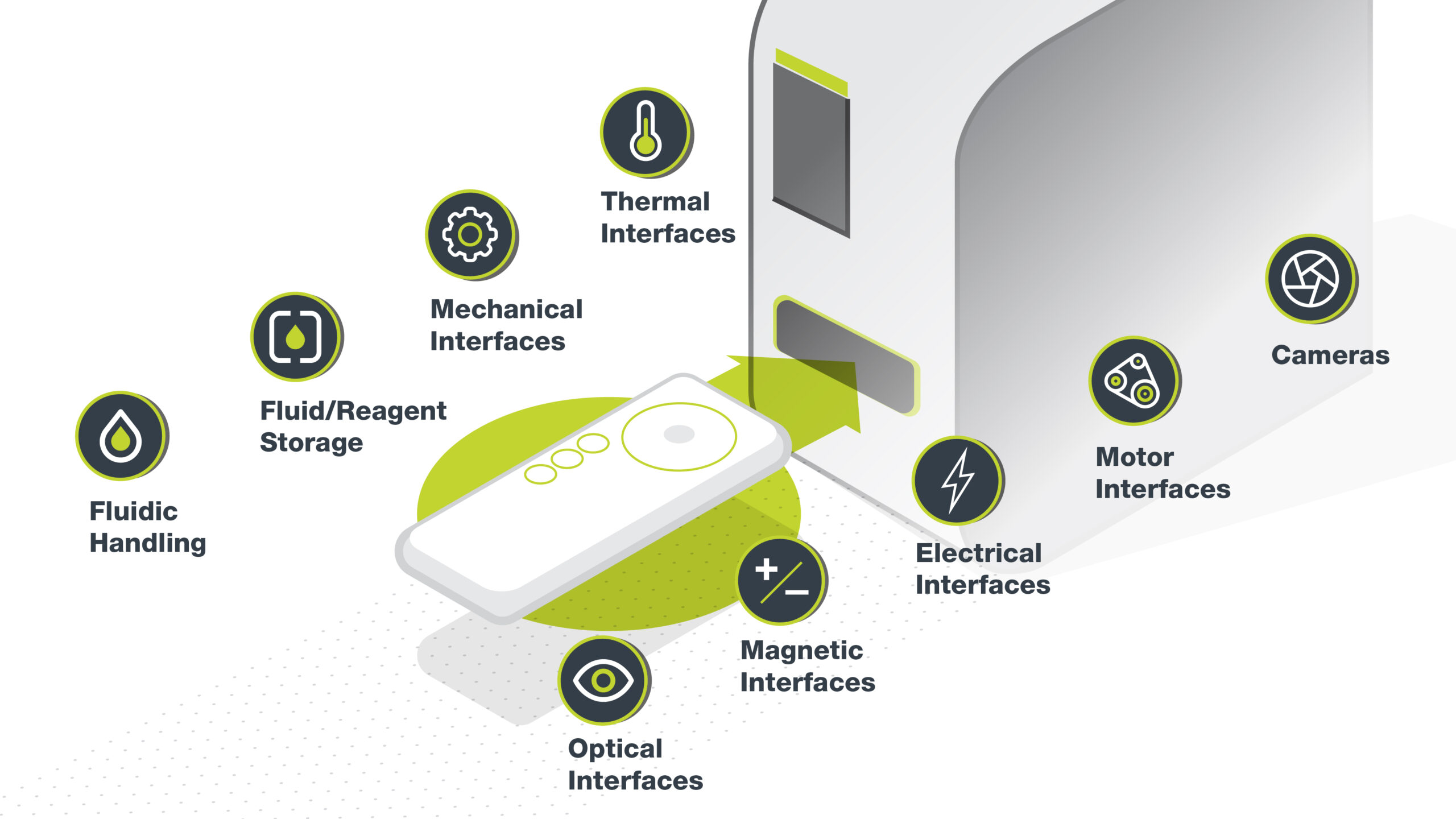
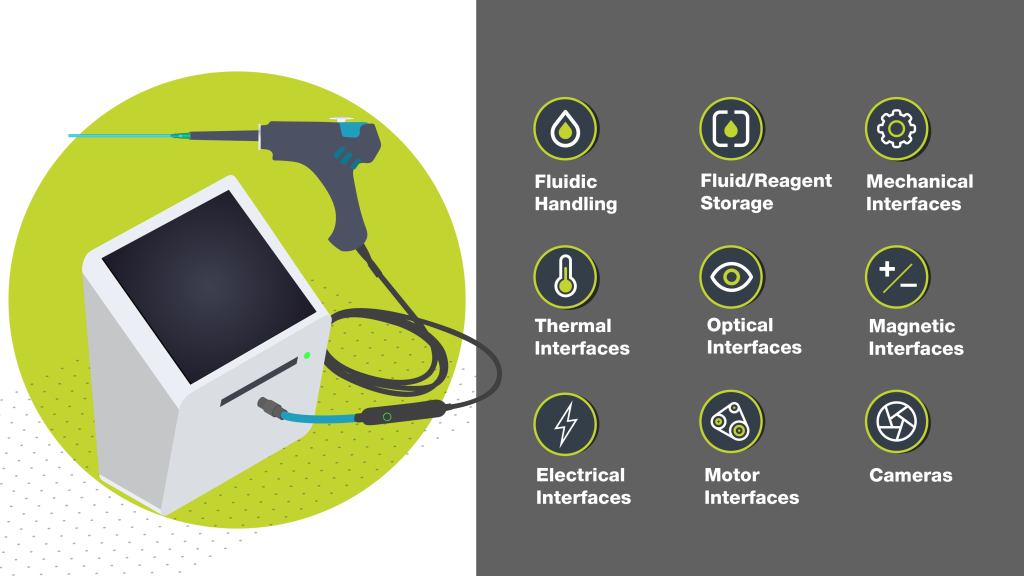
- Fluidic handling
- What is the fluid volume range the consumable should accommodate? Single microliter? 10 ml? 1 L?
- How will fluids be motivated? Blister and piston? Electronics?
- How will the characteristics of the fluid impact how it moves? I.e. blood, saline, urine, oil, viscous fluids like glycerol?
- How will the instrument be kept from touching fluid directly and being contaminated? Does the consumable need to be fully closed?
- Fluid/reagent storage
- How and where are fluids stored and introduced to the consumable/parts of the consumable?
- Will the fluids crystallize over time and cause clogging in the system?
- How will evaporation be prevented?
- In the case of lyophilized products used on the consumable, how should moisture block be implemented?
- Mechanical interfaces
- How is the consumable inserted or interfacing with the instrument?
- Are actuators required to pierce blisters containing fluids?
- Thermal interfaces
- How many temperature zones does the consumable need?
- How can the multiple temperature zones be best managed to minimize cross-talk?
- What thermocycling should be considered? What temperatures? How many cycles? How quickly?
- How will condensation be prevented?
- Does gas permeability of the consumable or humidity control of the sample need to be considered?
- Optical interfaces
- Does the system need optical sensors?
- Where does the light source need to illuminate?
- Are the optical properties of the consumable material compatible with the optical system?
- Magnetic interfaces
- Are magnets required? Where?
- Are there areas in the consumable where magnetic beads could settle or get stuck?
- Electrical interfaces
- Will the consumable require onboard electronics that can be produced cost-efficiently?
- In the case of onboard electronics on the consumable, how can the design ensure performance reliability given manufacturing variability?
- If the electronics on the disposable will not contact fluids directly, can they be easily disassembled and separated for sustainable downstream waste handling?
- Motor interfaces
- Is DNA extraction required? How should the motor be used to do this?
- Does the consumable need to be moved within the instrument?
- In the case of biologics products, how can the fluid be moved at flow rates that optimize cell viability and recovery rates?
- Cameras
- Does this system require an imaging system for fluid control or image analysis?
- Does the instrument require an imaging system to validate consumables?
- Biocompatibility
-
- Is a portion of the consumable or instrument in contact with the patient, biologics, or harsh chemicals? Is biocompatibility testing needed?
The importance of these questions cannot be overstated because the answers affect everything that comes after. By developing the consumable and instrument in parallel, these interdisciplinary conversations take place early and often.
3. Better System-level Test Design for Development
The one-vendor model enables rapid iterations on both consumable design features and instrument features. With flexibility to modify designs on either side quickly, this setup enables drastically improved efficiency in the test-optimize design iterations by reducing schedule and overhead, and can achieve better results by flushing out subtle but important design details early. When integrated prototypes are delivered to clients for product/chemistry/usability testing, this efficient setup can also mean faster turnaround of providing issue triaging, a systematic approach of problem-solving, and more transparent and coherent communications. Ultimately, the result is faster and better results, a better collaboration environment and experience, and fewer issues downstream.
4. Better Product Software/Firmware Decisions
Developing in parallel can also ease the headache of determining where specific software and firmware are installed. While typically the software and firmware are almost entirely found on the instrument, sometimes a consumable can have critical info such as the workflow steps or assay info loaded onto it. When this happens, it is a lot simpler to work with one team that can make holistic, educated decisions about what code needs to be developed, where it needs to be loaded, and the testing strategy for each software/firmware piece.
How Key Tech Can Help
“Our claim of integration is truly the case,” said Ben Lane, Key Tech’s VP of Product Development. “We have consumable designers and instrument designers who are literally sitting next to each other and talking to each other all day long.” The architecture phase is essential to getting a project started on the right foot, and our experience as a team is invaluable.
“Part of what enables that experience,” Lane says, “is that it is rare that someone leaves Key Tech. We have great retention and a collection of experience and knowledge under this roof that it makes that architecture phase go really well, so we can confidently dive into the design phase and not be worried about turning around and changing our direction.”
“The decisions that you make (with parallel development) happen more efficiently, more quickly, and are in the best interest of the program and not the organization,” Lane said.
Let our expertise and parallel approach lead to your commercial success. We want to work with you on your next durable/disposable interfacing product, whether it be in IVD, pharmaceutical drug delivery, life science, cell and gene therapy, or MedTech markets. Every challenge is different, tell us about yours.

A history nerd at heart, Alexis fits right into the quirky culture at Key Tech (though she still can’t speak binary). Weekends are spent chasing her two boys and spending time on her boat.
- Summer Interns 2026 - September 16, 2026
- Ep 46 Timeline from Concept to Clearance - September 3, 2026
- Ep 45 How We Ran a Clinical Study Without Millions - June 9, 2026