

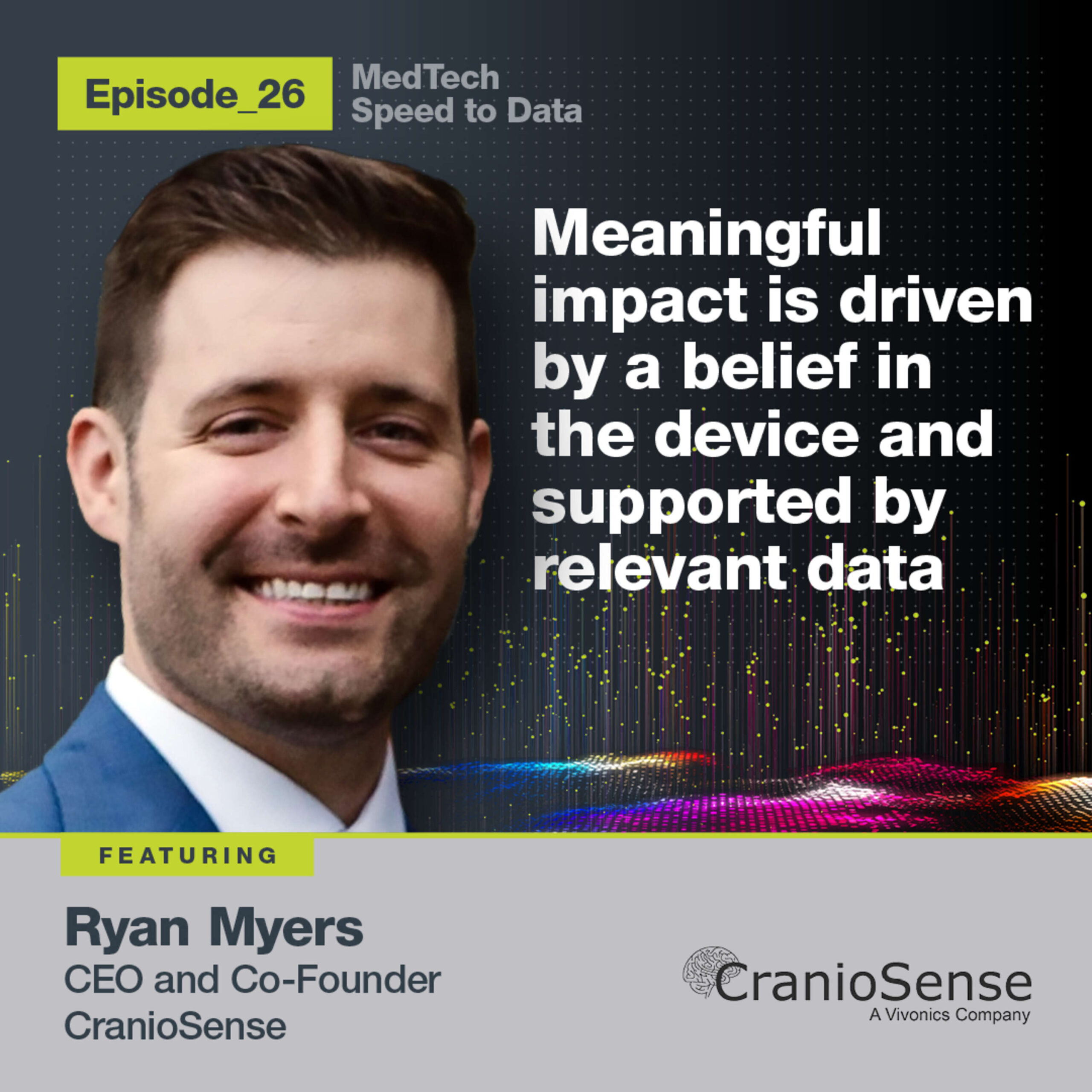
10 Jul Ep 26 Consider the Input- Ryan Myers
Many conditions can elevate or depress the intracranial pressure (ICP) of fluid pushing on the brain, potentially seriously impacting patient health.
However, the only ways to measure ICP require specialized invasive techniques that are too risky for most patients.
In Episode #26 of the MedTech Speed to Data podcast, Key Tech’s Andy Rogers talks with Ryan Myers, CEO and Co-founder of CranioSense, about developing portable, non-invasive ICP measurement technologies.
Need to know
Many conditions affect ICP — From traumatic brain injuries and tumors to heart or liver failure, many conditions can raise cranial fluid pressure on the brain.
Diagnosing brain injuries is tricky — For example, cerebral hypertension may present symptoms similar to concussions, but concussion treatments would increase intracranial pressure and could worsen patient outcomes.
ICP measurements are invasive — Inserting sensors through holes drilled into the skull or spine is the only way to measure pressure directly, so the risks limit its application to severe cases in hospital environments.
ICP is seldom measured — Only 2% of patients with traumatic brain injuries have their ICP measured, leaving doctors without vital patient data.
The nitty-gritty
CranioSense’s novel approach to non-invasive ICP measurement consists of a handheld tablet device and three infrared sensors placed on the patient’s forehead, earlobe, and fingertip. These sensors observe shallow blood vessels, allowing an algorithm to estimate ICP within seconds.
Early healthy human studies demonstrated a correlation between non-invasive blood pressure measurements and ICP, but commercialization and adoption will depend on proving that CranioSense’s technology accurately measures ICP.
“The gold standard is these invasive sensors,” Ryan explained. “We have to demonstrate to the clinical community that it is representative of the same [invasive] tools.”
Injured human testing is ongoing at seven sites around the country. Patients in neuro ICUs who already have invasive sensors also wear the CranioSense sensors.
“A pole-mounted system that sits in the ICU… essentially gathers our data but then harvests data out of multi-monitors that are already placed in the ICU.”
The combined data will improve the company’s diagnostic algorithms and bring the technology one step closer to market.
Data that made the difference
Startups depend on equity investors to carry a new medical device through regulatory approval and commercialization. However, there is another option.
Ryan explained how research grants accelerated his startup’s speed to data.
In CranioSense’s case, they had a funder with a particular interest in speedy, non-invasive diagnoses of brain trauma — the US Department of Defense.
DoD grants let CranioSense better understand its technology before designing the product. For example, their original approach relied on measuring an artery over the patient’s eye.
“That worked. It was just a human factors nightmare,” Ryan said. “The only way we would’ve gotten that data was to get in the clinic. That was something we saw and were able to pivot within the grants.”
Research grants got CranioSense to the data it needed faster, buying down technical risk, and putting the startup in a better position heading into the product design phase.
To hear more about this exciting new diagnostic technology, check out our conversation with CranioSense’s Ryan Myers in the full video here:

A history nerd at heart, Alexis fits right into the quirky culture at Key Tech (though she still can’t speak binary). Weekends are spent chasing her two boys and spending time on her boat.
- Summer Interns 2026 - September 16, 2026
- Ep 46 Timeline from Concept to Clearance - September 3, 2026
- Ep 45 How We Ran a Clinical Study Without Millions - June 9, 2026