
28 Oct How to Build and Manage your Dream Team for IVD Development
Listen to the Podcast
Watch
Deciding what resources to staff in-house vs. outsource is a critical question every project team needs to answer. In the case that building up internal product development and engineering capabilities is where you are headed, let us share some tips around how to build your team.
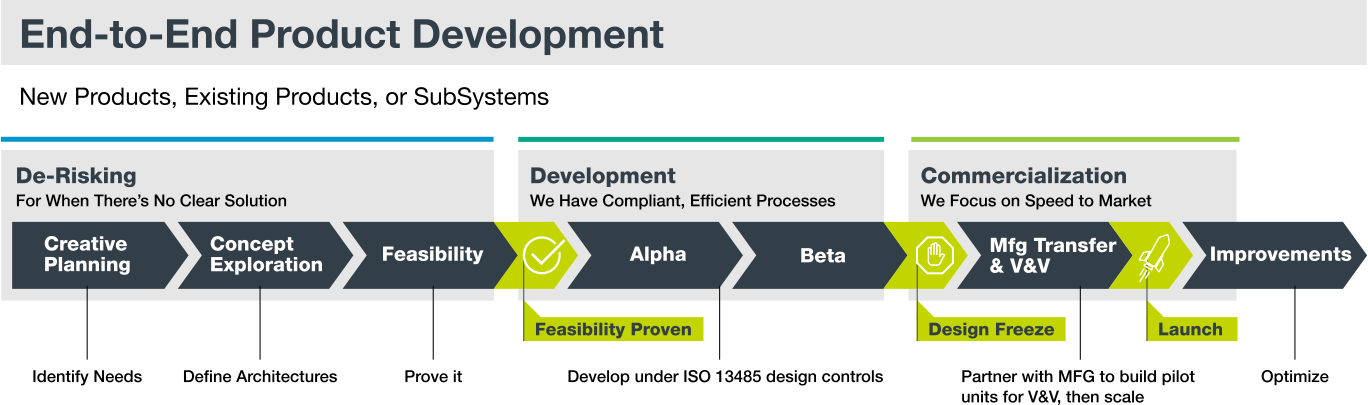
We specialize in end-to-end product development for medical, industrial and consumer products, but the largest segment of our business is in vitro diagnostic (IVD) platforms. So we understand what it takes to take an IVD device from bench to market.
Over the years, we’ve built an interdisciplinary team of engineers, and designers focused on IVD development – in partnership with companies large and small – whose primary focus is on the assay. Having done this for over 20 years, we want to share with you:
- How to get the right people in the right seats
- How to recruit effectively
- Which roles are most critical to project success
- How to manage these teams and keep the individuals motivated
- How to manage risk and failure
- How to have fun in the process
Putting the right people in the right seats
The “Assay is King” and the type of assay you want to create will drive your choices in personnel as well as product design. You tailor your team to the product: computer engineers, computer programmers, electrical engineers, mechanical engineers, industrial designers, and human factors engineers. You’ll need people with strong backgrounds in biochemistry and molecular diagnostics for certain. The specifics depend on the device itself – the reagents, the reactions that are occurring, and the types of samples going in.
Almost all IVD devices now incorporate a mix of software and firmware. And with everything being connected to the cloud, you’ll need people who know how to create that connectivity to your company’s other products.
Most diagnostic assays require microfluidic control manipulation. So you want people on your team who have good microfluidic backgrounds: people who have done complex CFD modeling of how fluids move through a cartridge.
But regardless if you’re a startup or a global company, you can’t build an IVD Dream Team with a snap of a finger. Timing is critical, and always challenging. You wouldn’t hire people and expect them to be a fully integrated team on Day One. They need time to get to know each other’s styles, each other’s strengths, and weaknesses, and how to complement each other.
Where do you find your team?
Let’s face it; recruiting is very challenging these days. But these three Rules of Thumb can make your search more efficient.
- Create a job description based on detailed technical skill sets and your specific needs.
- Make sure you’re recruiting at the right place. Identify how and where to find good candidates: schools, industry connections, and search firms.
- Decide how you are going to evaluate candidates. How do you assess someone who has the skills you need to do the job? It can be as formal as laying out an interface specification detailed bullet by bullet and asking how certain parts of the system are going to mesh with others. Ask how they’ve handled failures. Why that first run on that cartridge didn’t work. How did they problem-solve their way out of it? Or toss out that challenge, and inquire: “Hey, I just built this PCR related heater, and it has to go up against the cartridge. I ran my first test and I’m not getting the temperature ramp rates I expected. What would you do?” Let them talk you through the problem.
For your team, go with a mix of seniority: people with years of real-world experience, balanced with junior people who bring new ideas into the mix and are acquainted with the latest technologies.
Mix it up with diversity in education, gender, and race, too. Above all, understand that everyone’s brain is wired a little differently, and all these different perspectives are a good thing when you’re brainstorming or trying to solve a particularly challenging problem. Some people will analyze a problem with modeling calculations. Others may say “Let’s build it, test it, and see how it works.” Each of these very different schools of thought can be valuable at different times.
Ultimately, you want to hire people that are unlike you, so that you’re hiring people who fill in your weaknesses. David Ogilvy, who became an advertising legend in the 50’s put a finer point on hiring. “If we all hire people bigger than ourselves, we build an organization of giants. If we hire people smaller than ourselves, we become an organization of midgets.”
The top two most critical roles
First, you need a technical project manager, someone who understands all the aspects of the project, and how all the pieces fit together. One “must-have” trait is an understanding of where the different disciplines overlap, and what are the most likely pitfalls. Certainly, cool-headedness is a must for a technical project manager, but there are other intangibles too. There will always be a million details on a project. So strong organization skills are needed, with the ability to sort out which key details each team member needs to know, and with the people skills to understand the strengths of your team members. For example, if you have a team member who’s great at testing, understanding when is the right time to draw on that expertise.
One of the most important– and sometimes underrated – roles is system engineer: someone thinking about where and how things connect as a system. Every project either succeeds or fails at those interfaces of disciplines. Whether that’s the interface between the cartridges, the instrument, or the interface between the software engineers and the electrical engineers or the interface between the chemists and the people who design the cartridge. The system engineer manages this crucial process.
Once you have these two positions filled, it’s easier to build out the rest of the team.
To manage your team, manage the players
Successful team management is built on close and frequent communication. You probably can’t communicate too much, especially with the implementation of a disruptive technology.
Every member of the team has his or her own bias: engineers have a different point of view from biochemists. But if they touch base frequently, it’s easy to understand the needs of the other person. For example, if you need “these” temperature set points, or “that” amount of sample mixed. The engineering team can easily tell you why that’s doable or not. And similarly, the engineering team may come in and say, “We can give you this much power in this portion of the heater, but we can’t do more.” If you’re constantly talking with each other and synching up priorities, everything flows smoother.
Zoom meetings, and various project management and team collaboration platforms, provide many avenues for teams to stay in close contact. But don’t overlook old-school methods: phone, email, or a shared word document still go far. If everyone agrees on what tools and processes will be used, and on meeting and communication frequency, you will set your team up for success.
To foster a great dynamic among your team, delegate tasks, and emphasize mutual respect and support. If people can’t respect and support each other, they’re never going to be able to build off each other.
How do you keep the team members motivated?
Some ideas are going to pan out and some aren’t. In the face of failure, it helps to have a clearly defined set of values. Keep in mind the big picture: what are you trying to solve here? What’s this product going to do? How many people will it help? If you step back at those challenging points and zoom back out to a 30,000-foot level to the impact of potential product, it brings the project back into perspective.
Understand what’s driving the people on your team to become successful. Are they doing this because they believe in the mission? Or maybe they really enjoy the specific tasks they’re working on, and they want to see that task succeed. Are they doing this because they enjoy working with other people? Make sure to see that everyone on the team has an opportunity to meet their own personal goals.
Understand how to manage risk and failure, as well as success
So let’s say, you’ve developed a good specification. You’ve done all the design reviews. With any new high-tech device, you can expect the unexpected the first time you fire it up. How will your team problem-solve their way out of it?
Debugging, or as we call it, “de-risking”, consists of characterizing the technology and studying the governing variables of interest that affect how it works. For example, if you have 10 new things in your latest prototype, and it’s not working, isolate variables. Figure out how you can turn off eight or nine of those new things and test them one at a time. Go back to a point of design that works. As you have confidence, introduce another layer, and see what ultimately breaks it, or what you need to study further.
You can learn more about the assessment process for assays by downloading our whitepaper.
Don’t forget to have fun
The journey of bringing a new technology to market will often take you along a bumpy road. There are twists and turns, and it’s easy to get wrapped up in day-to-day challenges.
Amid the intensity of the project, keep the mission in focus. Take on those challenges in a creative way. Try to keep it lighthearted, especially when the going gets tough. For example, at Key Tech, our products can temporarily take on some strange characteristics around April Fool’s Day. But good vibes are a 365-day thing. Even a one-second interaction can make things fun in a meeting.
Enjoy the moments, the interactions, your colleagues, the meetings, and keep a positive vibe. (That’s probably a good idea outside of work, too). Good luck with your Dream Team!

A history nerd at heart, Alexis fits right into the quirky culture at Key Tech (though she still can’t speak binary). Weekends are spent chasing her two boys and spending time on her boat.
- Summer Interns 2026 - September 16, 2026
- Ep 46 Timeline from Concept to Clearance - September 3, 2026
- Ep 45 How We Ran a Clinical Study Without Millions - June 9, 2026